martes, 28 de julio de 2020

LA OPINIÓN DEL PUEBLO: ROSARIO, LOS HUMEDALES Y LAS LLAMAS

Recientemente hemos publicado los principales resultados del estudio "Humo y fuego en las islas de Victoria: Encuesta de opinión y percepción ambiental en el Gran Rosario", que he realizado con mi colega Gustavo Fernetti, con quien integramos el Programa Espacios, Políticas y Sociedades.
Los resultados reflejan algunos componentes de la opinión pública en flujo en la esfera y espacio públicos rosarinos, y en estos resultados se puede observar con claridad la existencia de una alta preocupación ambiental entre les rosarines. Esta preocupación ambiental puede ser caracterizada como proambiental y se observan muy importantes componentes de valoración de los humedales.
La rabia, la impotencia también quedan reflejados en la encuesta, ante fenómenos que llevan décadas y que este año han tomado  magnitudes infernales con kilómetros de hectáreas arrasadas por el fuego.
los datos también dejan muy en claro que se identifica a los empresarios ganaderos como los responsables y que dentro de las instituciones políticas, el gobierno Provincial de Entre Ríos es el que concentra la evaluación más crítica.
Ayer 28 de julio, nuestro estudio estuvo en la portada del diario Rosario12, la filial para Rosario del Diario Página12.
Otros medios escritos y radiales también han cubierto la publicación de la encuesta, agradecemos el interés y la difusión.
La encuesta ya ha sido publicada en el repositorio de la Universidad Nacional de Rosario, y seguimos trabajando en ella, dentro de poco esperamos tener prospecto de publicar un futuro libro por UNR Editora colección digital, estaremos informando.
Links coberturas de prensa:

Links encuesta:

domingo, 12 de julio de 2020

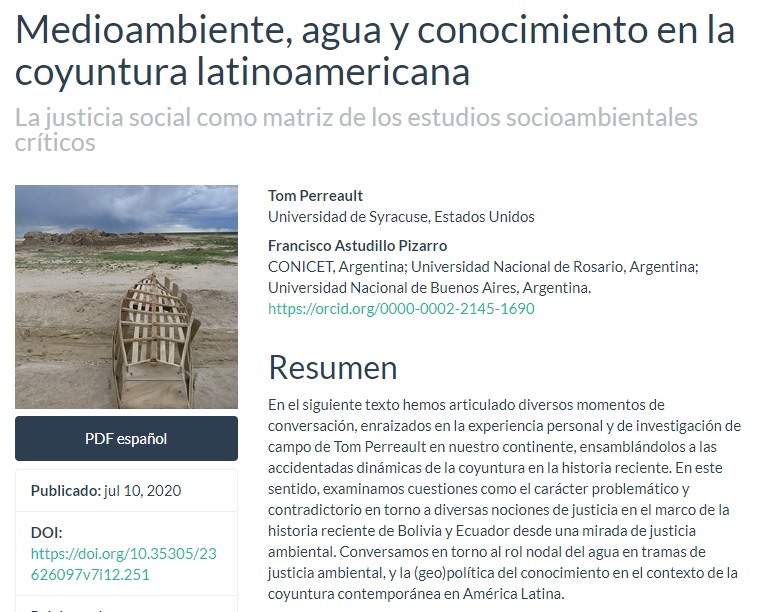
ENVIRONMENT, WATER AND KNOWLEDGE IN THE LATIN AMERICAN CONJUNCTURE

Recently, in the framework of monographic´s publication, volume entitled "Water, territories and spatial justice", jointly edited with Cecilia Galimberti and Doego Roldán in the A&P Continuidad academic journal, we have published a conversation with Tom Perreault, a prominent North American geographer with whom we had a interesting exchange on various topics of interest in the field of critical socio-environmental studies and the continental situation of Latin America.
The issue of research engagement, knowledge and global north-south relationships, and multi-scale tensions around environmental justice conflicts were some of the topics discussed.
I greatly appreciate Tom for the generosity and collaboration with this post.

Links:


jueves, 9 de julio de 2020

WATER, NETWORKS AND TOPOGRAPHIES OF POWER

Earlier this year the Arcadia portal published our work "Water flows an topographic networks of power: Social struggles for water in the Copiapo valley in the eighteenth century".

With this work we set out on the one hand to rethink historical processes linked to politics, water and territory during the late colonial period in the Copiapó valley, as well as to propose outlines of a theory of regional configuration processes that considers both the connecting flows, places and a wide series of human and non-human actants, as well as highlighting the relevance of incorporating the topographical dimension, both as a positive fact in the study of the territory, and also as a political metaphor.

On the other hand, the work tries to describe and analyze the social conflicts around water during the period, in which the physical topography was correlated to a series of power topographies based on the structure of political and economic asymmetries between the different classes. and estates in the valley.

Links:

domingo, 28 de junio de 2020

ENCUESTA DE OPINIÓN AMBIENTAL EN EL GRAN ROSARIO

Las quemas e incendios en los humedales entrerrianos y las islas de Victoria (frente a la ciudad de Rosario, Provincia de Santa Fe, Argentina) son una problemática que viene reiterándose desde por lo menos 20 años. En estas últimas dos décadas, diversas transformaciones en las infraestructuras de transporte generaron nuevas condiciones de rentabilidad que a su vez habilitaron el crecimiento de la industria ganadera en la región. El desarrollo de la ganadería ha ganado territorio en las islas, y derivada de esta actividad se han desarrollado agresivas prácticas como la de los incendios y quemas con el propósito de renovar tierras para pastizales.
Las quemas e incendios de este año 2020, que se han superpuesto a otros importantes fenómenos como la pandemia global por el COVID 19 y una histórica bajante en el río Paraná, han sido especialmente controversiales, y la polémica pública ha reabierto el tema, así como también se han recuperado estrategias de solución que habían quedado el el silencio y el olvido.
Durante las últimas semanas, diversas organizaciones ecologistas, académicas y de la sociedad civil se han movilizado para poner el tema en la agenda pública.
Es en ese contexto e intentando contribuir a la problematización pública de la cuestión, es que desde el Programa Espacios, Políticas y Sociedades del Centro de Estudios Interdisciplinarios de la Universidad Nacional de Rosario hemos desarrollado el estudio cuantitativo
"Humo y fuego en las islas de Victoria: Encuesta de opinión y percepción ambiental en el Gran Rosario".

Estaremos recolectando datos hasta el viernes 3 de julio.
Agradecemos la colaboración del Ciclo de Ecología, coordidano por el periodista Sergio Rinaldi.

Link: https://docs.google.com/forms/d/e/1FAIpQLSdkFUtn4qQWvgPp4T3t18hHeVyIfZ3Hak7EOzNxOUPkXCQLhQ/viewform?vc=0&c=0&w=1

AGUA, TERRITORIOS Y JUSTICIA ESPACIAL

Estamos finalizando el trabajo de edición del volumen "Agua, territorios y justicia espacial" (N°12, Revista A&P Continuidad de la Facultad de Arquitectura, Planeamiento y Diseño de la Universidad Nacional de Rosario, en la que he conformado equipo junto a la Dra. Cecilia Galimberti y el Dr. Diego Roldán como editores invitados.
En esta publicación hemos querido abrir puentes interdisiciplinarios para problematizar una serie de tensiones en las que el agua opera como un foco de articulación entre intereses y posicionamientos entre comunidades, Estados y fuerzas del mercado. Cruzando abordajes desde el ordenamiento territorial, la sociología, la historia, la antropología y la geografía.
Se viene interesante, diversos casos de estudio en Argentina y Chile, más la colaboración de destacados investigadores a nivel internacional.
Esperamos publicar la versión On-line en las próximas semanas.
Estaremos informando.

lunes, 29 de julio de 2019

SPATIAL JUSTICE, SOCIONATURAL DISASTERS AND POLITICS OF SPACE


In Volume 28, N°2 (2019) of Journal Cuadernos de Geografía: Revista colombiana de geografía our latest work in collaboration with my dear friend and colleague Dr. José Sandoval Díaz has been published, entitled "Spatial justice, socionatural disasters and politics of space: Sociopolitical dynamics in view of the floods and recovery processes in Copiapo, Chile" (Astudillo Pizarro, 2019). In this article we have proposed two aims, one theoretical and one empirical, with  the first one we wanted to explore the theoretical and conceptual bridges between the field of spatial justice and the sociological disasters and risks, recovering the Lefebvrian notion of Politics of Space; while in relation to the background, we made an empirical and comparative contrast examining the sociopolitical dynamics of organization and mobilization in three localities in Copiapó, in the Atacama region (Chile), which were severely affected in the May floods of 2017. This empirical analysis accompanies the post-alluvial process, and sought on the one hand to test the previously assembled theoretical reflections, and on the other, to relieve the dimension of the agency of communities and populations within the framework of post-alluvial processes in the 2017-2018 period against socionatural and political constraints. 
It is an ethnographic work with important spatial components, which also incorporate elements of the ethnography of virtual spaces that expand the ethnographic field to the new instances of sociability and virtual communication, highlighting the role of these instances and technological mediations in the framework of the production of new public spheres and the dynamics of response of the communities in the processes of problematization of the risks and the maturation of a socionatural understanding of the disasters that incorporates a critique of the subsidiary State´s role and the market economy.
Those dynamics of organization, mobilization and enunciation show that, both the consequences of the floods and the problematization of the risks are crossed by different demands of spatial and environmental justice, which problematize the distribution and distribution of the risks, the demands for the recognition of territorialized communities and procedural forms of justice in which legitimacy emerges in tension with normative legality, shaping emerging forms of risk governance. Localities, communities and populations that place their focus on claims in the State, also making visible the ghostly role of the market in the intensification of risks for populations and communities.
The notion of Space Policies, taken from Henri Lefebvre, allowed us to problematize those dynamics from above and from below, whether from the policies of space production, financing, decision, design and execution of territorial ordinances and rearrangements, to multiple practices of negotiation, resistance, appropriation and mobilization of local actors against these structural conditions, interspersing theoretical elements of structure and agency in our analysis.
The sociopolitical analysis shows that territorial planning constitutes a new focus of dispute, processes in which rescuing the notion of "critical agents of urban planning" proposed by Marcelo Lopes de Sousa, we show how communities mobilize "with", " in spite of ”, and“ against ”the State against space policies that sacrifice the population against possible risks and proven effects after the floods of 2015 and 2017 in the region studied.

martes, 2 de julio de 2019

GEOPOLITICAL FLOWS OF PARANA RIVER

Parana River 2019, Rosario city, Argentine.
The Paraná River is not only an impressive landscape, its monumental river currents are also metaphors of its historicity. Its long history of explorations highlights its strategic geopolitical character, which makes it impossible to think about its history alone, but above all its present, through the lens of hydropolitics.

The Paraná river is also a huge infrastructure of the production modes of agro-export extractivism. Enormous transnational ships parade in front of Rosario City (Argentine) through the Paraná-Paraguay waterway, currently concessioned to Belgian capital until 2021. The renewal of its concession has awakened the lobby of Dutch, Belgian and Chinese capital interested in taking over the new privatization fluvial cycle.